








High ambient temperatures across the Emirates routinely push rooftop water tank readings above 45°C during peak summer months, making active cooling a practical necessity rather than a luxury. Navigating the market of water chillers companies in UAE requires a clear understanding of cooling capacities, climatic durability, and application-specific engineering. Whether cooling a private residence or regulating industrial machinery, choosing the right setup protects daily comfort and operational continuity.
Understanding Residential vs. Commercial Cooling Needs
Water chillers operate by circulating water through a closed-loop refrigeration cycle—removing heat via an evaporator and releasing it outdoors through a condenser—until the storage tank reaches a preset target temperature. However, the scale and mechanical demands differ sharply between residential and business installations.
Domestic Water Chiller System Specifications
A Domestic water chiller system is engineered to keep household water supplies comfortable for bathing, kitchen use, and private swimming pools. Key features to evaluate include:
- Tank Capacity Matching: Units typically range from 1.5 to 5 tons, designed to cool rooftop tanks holding between 500 and 2,500 gallons.
- Target Temperature Control: Digital thermostats generally maintain tank water between 22°C and 28°C, automatically shutting off the compressor once the threshold is reached to conserve electricity.
- Acoustic and Footprint Efficiency: Modern residential units utilize low-noise fan blades and compact weatherproof enclosures suited for villa rooftops or side yards.
Commercial Water Chiller System Applications
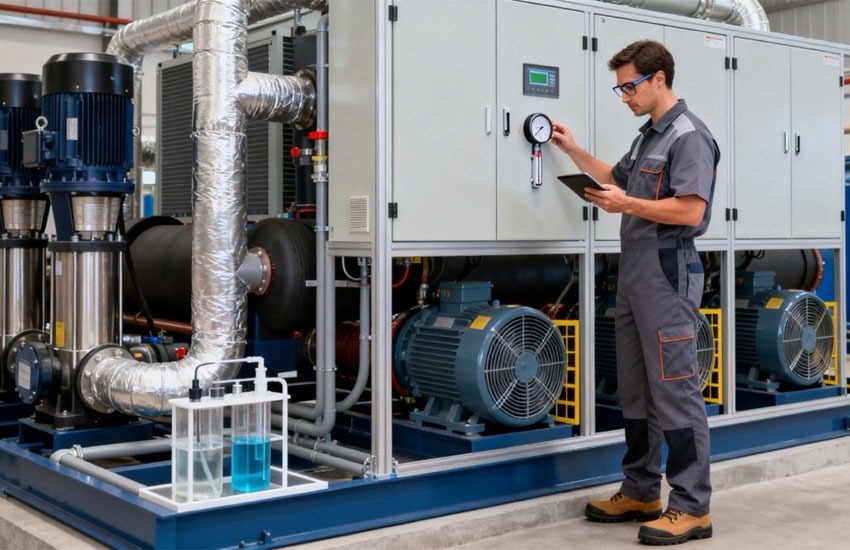
A Commercial water chiller system handles continuous, high-load thermal demands where temperature fluctuations can disrupt business operations or damage equipment. Common environments include:
- Hospitality and Retail: Hotels, shopping malls, and residential towers requiring consistent chilled water across hundreds of outlets.
- Manufacturing and Plastics: Injection molding, chemical processing, and food production lines needing strict process temperature stability.
- IT and Healthcare: Server rooms, data centers, and diagnostic laboratories where precision cooling prevents hardware overheating.
Key Factors When Evaluating Suppliers
Partnering with experienced water chiller suppliers in dubai ensures the equipment is built specifically for Gulf climatic conditions rather than standard temperate zones. Before finalizing any system, facility managers and homeowners should verify four technical benchmarks:
- High-Ambient Condenser Design: Look for T3-rated compressors and anti-corrosive blue or gold fin coils capable of operating reliably in ambient temperatures up to 52°C.
- Eco-Friendly Refrigerants: Prioritize systems charged with R410A or R134a refrigerants, which offer strong heat-transfer efficiency while meeting regional environmental regulations.
- Built-In Electrical Protections: Phase-loss monitors, high/low-pressure cut-offs, and overload relays safeguard compressors against sudden voltage fluctuations.
- After-Sales Service and Spare Parts: Local technical support, preventive maintenance contracts, and readily available replacement components minimize downtime during peak summer heat.
For project planners, engineers, and homeowners comparing technical specifications for residential or heavy-duty installations, reviewing established regional specialists such as Water Chillers UAE provides a helpful reference for sizing and climate-adapted system designs.
Frequently Asked Questions (FAQs)
- What size water chiller is required for a standard UAE villa?
A 3-to-4-bedroom villa with a 1,000-gallon rooftop tank typically requires a 2-ton chiller. Larger 5-to-6-bedroom residences or properties with swimming pools generally require a 3-ton to 5-ton unit.
- How much electricity does a domestic water chiller consume?
Once the tank reaches its preset temperature—usually around 26°C—the automated thermostat cycles the compressor off. Because it runs intermittently rather than continuously, a properly sized residential unit consumes roughly the same power as a standard split air conditioner.
- What is the difference between air-cooled and water-cooled chillers?
Air-cooled chillers dissipate heat directly into the surrounding air using fans, making them simpler to install and maintain without extra water consumption. Water-cooled chillers use cooling towers and are typically reserved for massive industrial plants where high thermal efficiency is required.
- How often should a water chiller system be serviced?
Residential systems should undergo preventive servicing twice a year—ideally before and after summer—to clean condenser coils, check refrigerant pressure, and inspect circulation pumps. Commercial systems operating 24/7 generally require quarterly maintenance checks.
- Can a water chiller be connected to an existing rooftop water tank?
Yes. Most modern chillers use an external closed-loop circulation pump that draws warm water from the existing tank, cools it, and returns it without requiring tank replacement.
Click on this https://terasworld.com/ to get more such information.