









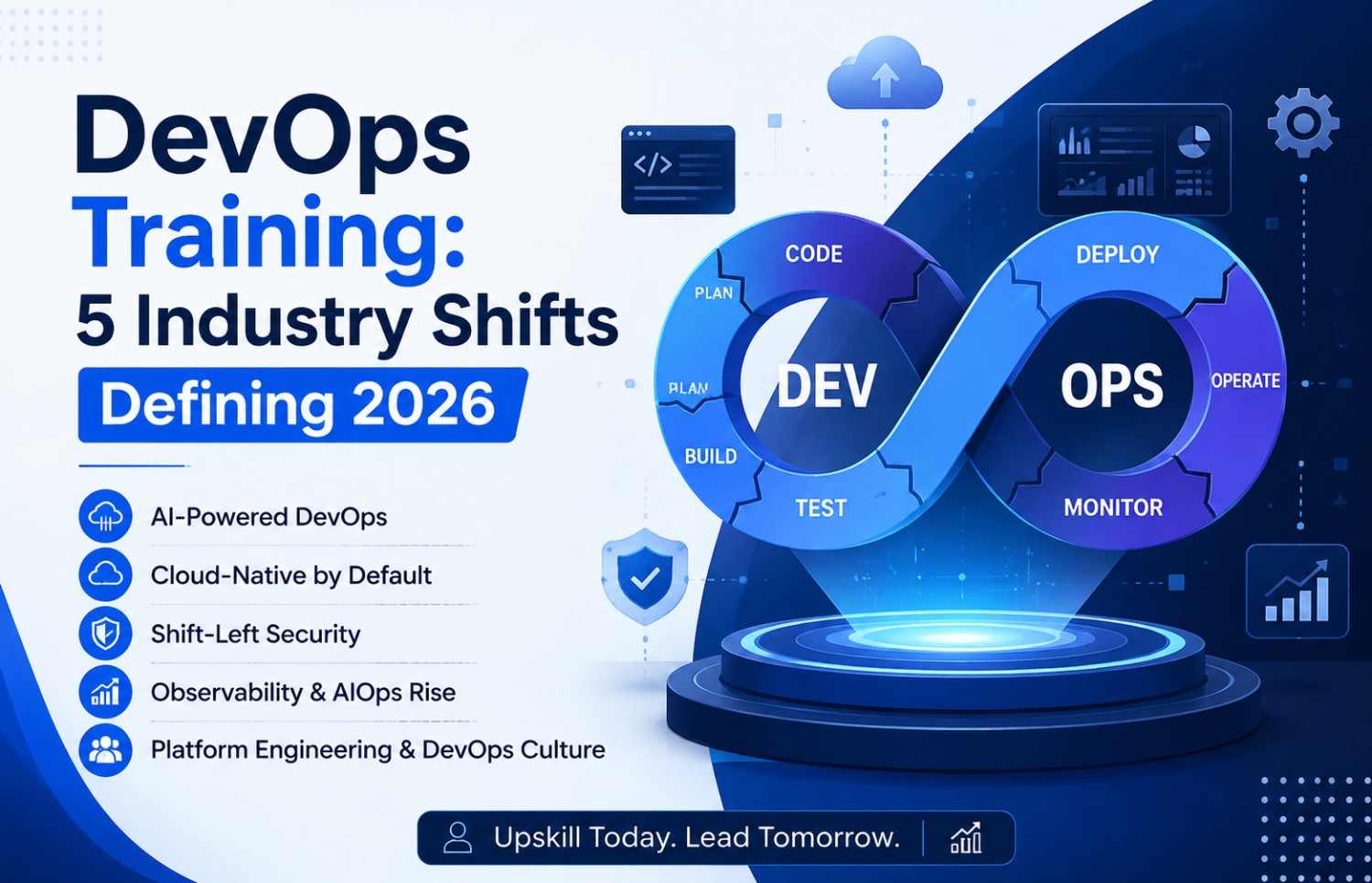
The enterprise technology environment across the global IT sector has reached a decisive turning point. The days when DevOps merely meant linking basic code repositories to simple automated build servers are long gone. In 2026, modern software engineering demands full-stack delivery frameworks capable of supporting cloud-native microservices, AI-generated codebases, and automated zero-trust security postures.
As organisations accelerate their reliance on continuous deployment, traditional systems administration and isolated quality assurance roles are being phased out. To remain competitive, tech professionals must undergo structured, forward-thinking DevOps Training that reflects these modern operational realities.
Here are the five critical paradigm shifts defining software execution in 2026—and how mastering them through high-impact upskilling secures your future in tech.
5 Paradigm Shifts Redefining Enterprise DevOps
- The Rise of Platform Engineering and Internal Developer Platforms (IDPs)
The classic expectation that every developer must configure their own complex infrastructure setups has created immense cognitive overload. In response, enterprise organisations are building dedicated Internal Developer Platforms (IDPs). Platform Engineers construct self-service portals that allow software developers to provision environments, deploy applications, and manage databases independently without waiting for manual operational sign-offs.
2. AIOps and Generative AI-Driven Pipelines
Automation in 2026 extends far beyond static bash scripts. AI-native DevOps integrates machine learning algorithms directly into the software development life cycle (SDLC). Modern delivery engineers leverage AI to:
- Auto-generate infrastructure-as-code (IaC) templates.
- Predict pipeline deployment bottlenecks before they occur.
- Analyse complex system logs to provide automated root-cause analysis during live incidents.
- Execute self-healing deployment scripts that dynamically resolve system failures.
3. DevSecOps: Shifting Security Left into the CI/CD Pipeline
Security is no longer a final audit phase executed right before product release. Modern software delivery demands “DevSecOps”—the seamless embedding of automated security checks into every phase of the CI/CD pipeline. From static application security testing (SAST) and dynamic scanning (DAST) to continuous container vulnerability checks, security compliance is now completely automated.
4. Cloud FinOps and Automated Cost Optimisation
With enterprises scaling across multi-cloud infrastructure models, uncontrolled cloud spending has become a major executive concern. DevOps engineers are now required to embed Financial Operations (FinOps) principles directly into their deployment workflows. Modern pipeline managers utilise automated resource-scaling policies, monitor real-time cost-per-deployment metrics, and configure automated scripts to terminate idle cloud environments.
Also Read: BBA Event Management Course in Delhi: What Students Should Know Before Admission
5. GitOps and Declarative Infrastructure Management
Declarative configuration management has become the global standard for cloud-native deployment. Through GitOps methodologies, Git serves as the single source of truth for both application code and infrastructure state. Utilising automated reconciliation engines, any drift between the live production environment and the underlying Git repository is automatically detected and corrected.
Why Upgrading Your Career with StarAgile Is Essential
Navigating these complex, multi-tool environments requires practical, hands-on instruction grounded in actual enterprise scenarios. While self-study video tutorials offer high-level theoretical overviews, they frequently lack the live production environments and daily mentorship needed to master complex, real-world deployment challenges.
Enrolling in an official, industry-aligned training track with StarAgile bridges this gap by delivering a comprehensive, job-ready curriculum tailored to modern enterprise standards.
Choosing a live, virtual training program allows working professionals to gain extensive practical expertise without disrupting their daily commitments. Learners can configure multi-stage CI/CD pipelines, deploy containerised microservices, and manage declarative cloud environments right from their home office.
How Training Platforms Compare Head-to-Head
| Key Selection Criteria | Self-Paced Video Libraries | Standard Training Hubs | StarAgile Advantage Program |
| Learning Architecture | Pre-Recorded Modules | Rigid Classroom Setup | 150+ Hours Live Virtual Classes |
| Generative AI Add-Ons | Excluded | Minimal Coverage | Fully Integrated AI-Native DevOps Modules |
| Tool Stack Breadth | Basic CI/CD Scripts | Standard Jenkins Setup | AWS, Docker, Kubernetes, Ansible, Git & Nagios |
| Practical Experience | Static Exercises | Basic Code Snippets | 100+ Hours Practical Labs & Capstone Projects |
| Post-Course Placement | None Offered | Basic Resume Templates | 4 Interview Calls/Month Career Track |
Why StarAgile Is the Premier Partner for DevOps Professionals
StarAgile has advanced the career trajectories of thousands of tech learners globally by providing practical, high-value upskilling programs. Their intensive DevOps certification track transforms theoretical infrastructure concepts into actionable operational skills.
Core Highlights of StarAgile’s Training Program:
- Comprehensive Stack Coverage: Master essential foundations in Linux administration, Shell scripting, Python automation, Git, AWS Cloud Infrastructure, Docker containerization, Kubernetes orchestration, Ansible configuration management, and Nagios monitoring.
- Live Mentor-Led Virtual Delivery: Gain direct access to certified enterprise practitioners who bring over a decade of real-world operational experience to every session.
- AI-Native Pipeline Automation: Learn how to leverage modern artificial intelligence platforms to auto-generate deployment scripts, optimise YAML configurations, and automate troubleshooting.
- Dedicated Placement and Career Support: Eligible candidates receive comprehensive career support, including resume optimisation, technical mock interviews, and access to an expansive hiring network.
Conclusion
Succeeding in the fast-paced software delivery ecosystem of 2026 requires moving beyond basic scripting into full-scale pipeline orchestration, cloud infrastructure engineering, and AI-driven automation. Completing an industry-aligned training track with StarAgile equips you with the practical skills, production-level confidence, and credentials required to lead high-velocity engineering teams. By combining live expert mentorship, extensive practical labs, and robust career support, StarAgile provides the ultimate platform to transform your technical career and secure high-value DevOps positions.