









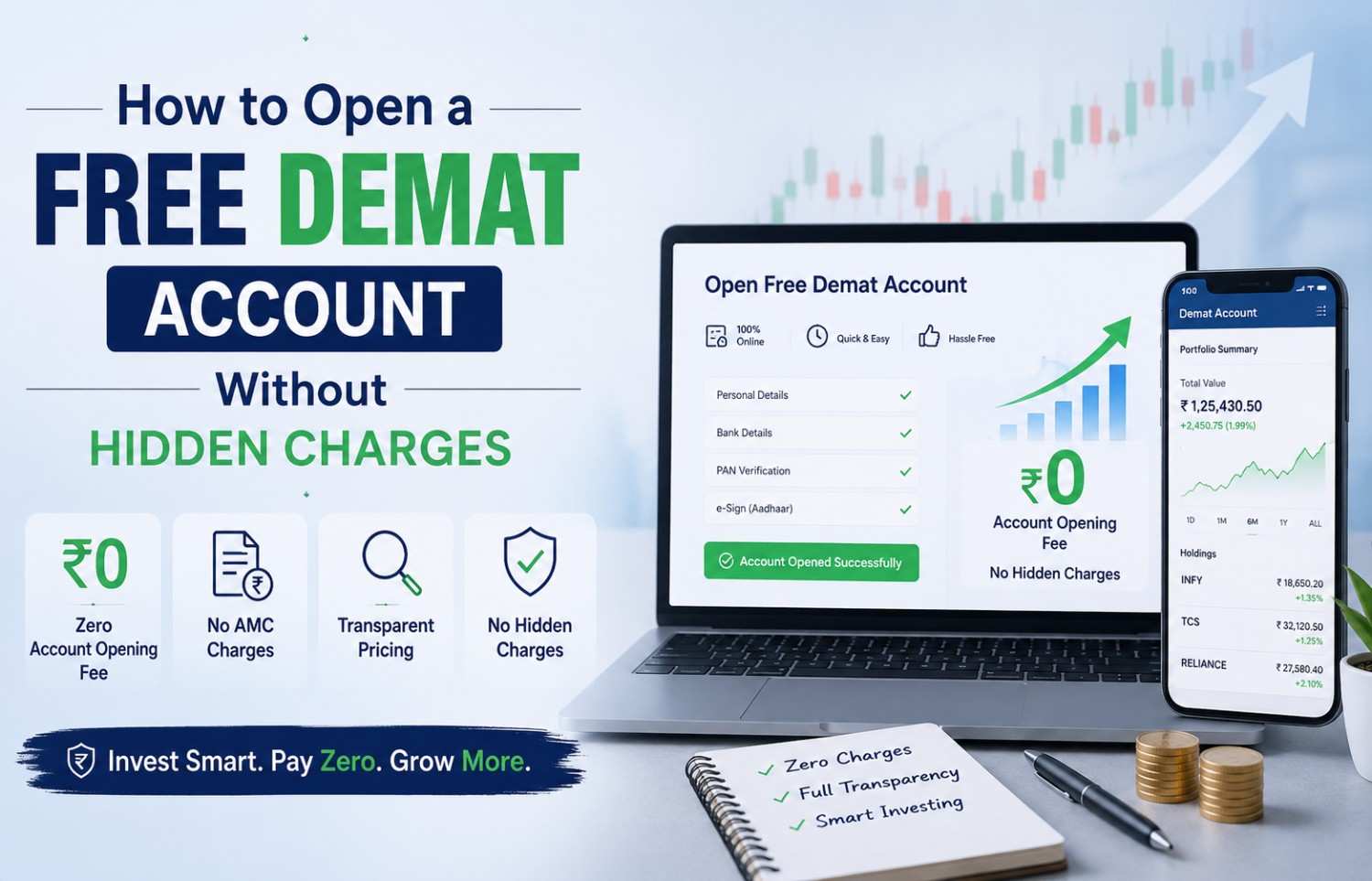
If you are planning to invest in stocks, ETFs, mutual funds, IPOs, etc., you are required to open a demat account. But demat accounts generally have various hidden charges.
Now we will explain everything to you related to hidden charges while opening a demat account.
What is a Demat Account?
A demat account is an electronic account offered by a broker in which one can store their securities in electronic form. Using this account, one can also buy and sell securities such as shares, bonds, SGBs, ETFs, etc. It is a type of digital locker for your investment. It is mandatory to open this account if you want to invest in shares.
What Does a Free Demat Account Mean?
This demat account is usually free means the broker does not charge any fee for opening the account. However, it does not mean that all other charges, such as annual maintenance fees and brokerage, are not applicable; they are still charged by the broker. Therefore, it is necessary to understand the complete fee structure of a broker.
What are the Hidden Charges Involved in a Demat Account?
The hidden charges involved in a demat account are as follows:
- Annual Maintenance Charges: This is the most common type of charge that is applicable to almost all types of demat accounts. However, the charges vary from broker to broker and the type of plan that you have opted for. It is necessary to check that the AMC is free for life, free for only the first year, or charged annually.
- Brokerage Charges: If you get an opportunity to open a lifetime free demat, you still need to bear the brokerage charges on every buy and sell order. These charges are applicable on delivery, intraday, derivative trades, etc.
- DP Charges: The depository participant charges are often ignored by investors. These charges are applicable when any shares are debited from your demat account, and it is charged by the depository participants. This is different from the brokerage charges.
- Account Opening Charges: There are various broker that charge a one-time fee to their investor at the time of opening a demat account.
- Call and Trade: If a trader places an order through a dealer over call instead of using a mobile application, they will be charged INR 20 to 50 per executed order.
- Pledge and Unpledge Charge: If you are using the margin trading facility provided by your broker and pledging and unpledging your shares using their service, they may charge a certain amount for each transaction.
- Interest Charge: If you are using the margin trading facility and borrow funds from your broker, they charge certain interest on it. However, the rate of interest can vary depending on the broker.
- Failed Payment Charges: In case any standing debit instruction given to your bank in favour of the broker may fail or bounce, it may charge a certain penalty on you.
- Statutory Charges: Other than brokerage, there are certain government charges that are mandatory to be paid, such as GST, STT, Stamp Duty, etc.
How to Open a Demat Account?
One can open a demat account by following the steps mentioned below:
- Visiting Website: To open a free demat account, one must visit the website of the broker and click on the tab “Open Demat Account”.
- Consent: Consent from your end is required to process the KYC and open a Demat account.
- Verification of Mobile Number and Email ID: Afterwards, you will be asked to verify your mobile number and email ID through an OTP sent on the same.
- KYC: To complete the KYC, an investor will be given two options: either they can go for DigiLocker or upload the documents, along with a selfie, to verify their identity.
- Bank Details: Then they are required to submit their bank details along with the FATCA.
- Segment Selection: The selection of a segment will be the next step, and they are required to select the segment in which they wish to trade.
- Signature: Then, in the final step, you are required to upload or draw your signature.
- Final Submission: After this, you are required to e-sign the application using the Aadhaar OTP.
- Login Credentials: Once you complete all the steps successfully, your demat and trading account will be opened, and you will receive the login credentials on your registered email ID.
How to Identify a Low-Cost Demat Account?
To identify a low-cost demat account, one can follow the steps mentioned below:
- Check Account Opening Charges: The first step is to check for a broker offering zero account opening charges and having a free KYC process, along with no hidden charges.
- AMC: The next charge that is required to be compared is the annual maintenance charges. One must look for a company offering zero or low AMC, along with some lifetime free AMC plans.
- Brokerage Charges: Brokerage charges constitute a major component of your expenses. Therefore, it is necessary to compare the brokerage fees offered by various brokers.
- Other Hidden Charges: There are various charges applicable to a trader charged by the broker. These are not generally known to a client it includes physical account statements, SMS alert charges, call and trade services, etc.
- Details of Charges: The best possible way to identify the charges of a broker is to review their pricing document. It contains all the charges, such as AMC details, brokerage rates, penalties, etc.
Therefore, it is necessary that an investor should compare the top demat accounts in India based on their complete structure related to pricing, to avoid any unnecessary cost in the long run.
Also Read: How the Best BBA Event Management in Delhi Prepares You for the Global Events
Conclusion
On a concluding note, opening a demat account is the first step that is required while investing in stocks. But it is not necessary that the accounts are always free; there are various hidden charges applicable to a demat account. These hidden charges are very small in amount but can have a significant impact in the long-run. Therefore, it is advisable to evaluate and compare all the charges such as DP charges, annual maintenance charges, brokerage fees, pledge charges, etc. However, it is not advisable to go only for the brokers offering minimal charges; their services, mobile applications, reliability, etc, also need to be considered before opening a demat account.
Disclaimer – The securities, funds, and strategies mentioned in this blog are purely for informational purposes and are not recommendations.