









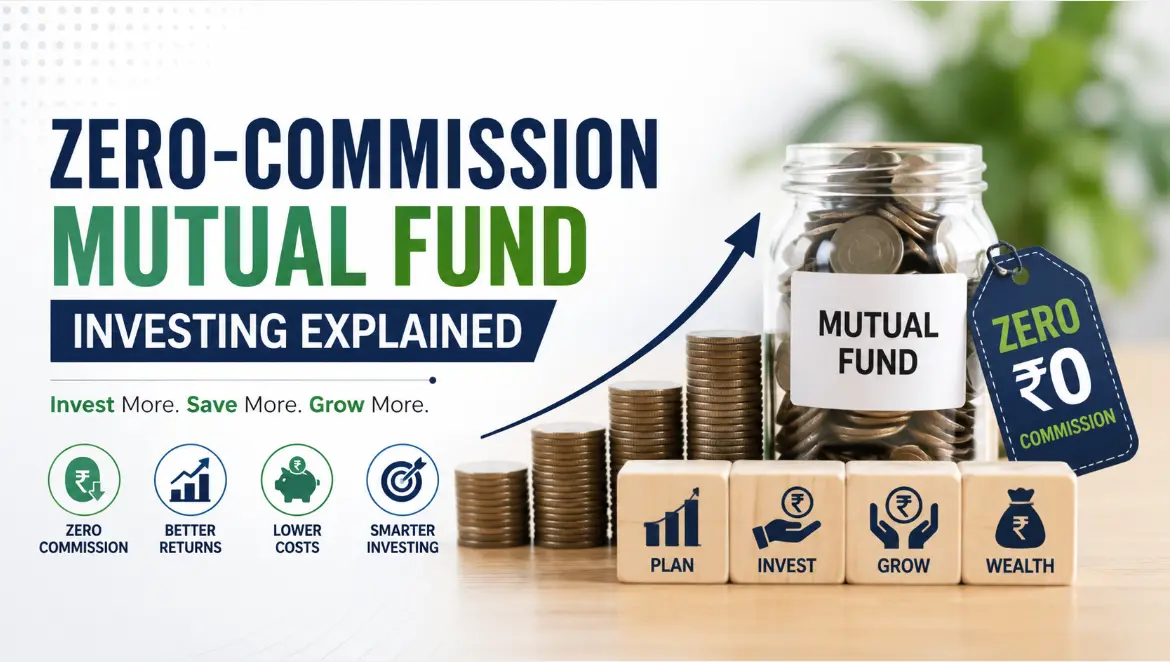
For many years, most investors were unaware of the hidden cost associated with investing in mutual funds. Year after year, commissions paid to distributors and middlemen subtly decreased returns, which over time added up to a substantial degradation of wealth. Without considering whether there was a better option, many investors just accepted this as a typical cost of participation.
Investing in zero-commission mutual funds has completely altered that discourse. It signifies a major change in the way regular investors invest in mutual funds, accessing financial markets fairly, openly, and without needless extra layers depleting their hard-earned profits. It is no longer optional to comprehend how this model functions, why it exists, and what it actually means for your long-term wealth. Understanding this is crucial for every investor who is serious about financial progress.
1. What Zero-Commission Actually Means in Simple Terms
When you engage in zero-commission investing, no distributor, agent, or intermediary is compensated for helping you make a mutual fund investment. You make direct investments with the fund house, and all of your money is instantly put to use in the market; no money is taken out as sales commission. The removal of distributor commissions alone results in a quantifiable and consistent improvement in the returns investors actually get and keep, but this does not imply that the fund operates without any expenses—fund management fees still apply.
2. Why This Model Did Not Always Exist for Everyone
For many years, commission-based mutual fund distribution dominated the market since it was the main way that money got to regular investors. In return for recurring commissions included in the fund’s expense ratio, distributors instructed, counselled, and onboarded investors. Eventually, regulatory evolution realized that this arrangement led to conflicts of interest and disadvantaged investors who did not require advisory assistance. This legislative push for more equity, openness, and true investor-first thinking in the financial services sector gave rise to direct plans and zero-commission platforms.
3. The Cost Saving Is Automatic and Requires No Effort
The fact that zero-commission investing saves money automatically without the investor’s active participation is one of its most alluring features. After investing in a direct or commission-free plan, the investor doesn’t have to constantly monitor, bargain, or opt in to benefit from the lower expense ratio. Alongside the investment itself, the advantage compounds discreetly. Zero-commission investing is especially appealing to long-term investors who want a simple, low-maintenance method of steadily increasing their wealth because of the passive, frictionless nature of the cost savings.
4. Portfolio Returns Reflect the True Fund Performance
The returns an investor sees more closely match the real performance of the underlying fund portfolio when commissions are eliminated from the investment structure. There is a continuous discrepancy between what the fund makes and what the investor receives in commission-bearing plans since a percentage of fund returns are constantly diverted toward distributor remuneration. This disparity is significantly reduced by zero-commission investment. Instead of seeing returns that have already been subtly lowered before they appear on their account statements, investors may now assess fund performance on its true merits.
5. Ideal for Investors Who Have Done Their Own Research
Investors who take personal responsibility for their financial decisions are especially well-suited for zero-commission mutual fund investment. Distributor advice is not really necessary for those who investigate fund categories, comprehend risk profiles, evaluate past performance, and establish their own investing objectives. Paying recurring commissions is a complete waste of money for many self-directed investors. The zero-commission model honours and rewards investor expertise by providing full market access at the most affordable price to individuals who are prepared to carefully consider their own financial planning and decision-making.
Conclusion
Investing in zero-commission mutual funds is a long-term and beneficial development in the way financial markets assist regular investors, not a fad. The top trading app like HDFC SKY guarantees that more of every rupee spent goes toward creating true long-term value by eliminating needless cost layers and also making sure that users easily invest in mutual funds. The idea is straightforward, the advantages are genuine, and the long-term effects are significant. Zero-commission investing is not just a desirable alternative for investors who value efficiency, transparency, and making every rupee work in their favour; it is now the most financially wise option.