









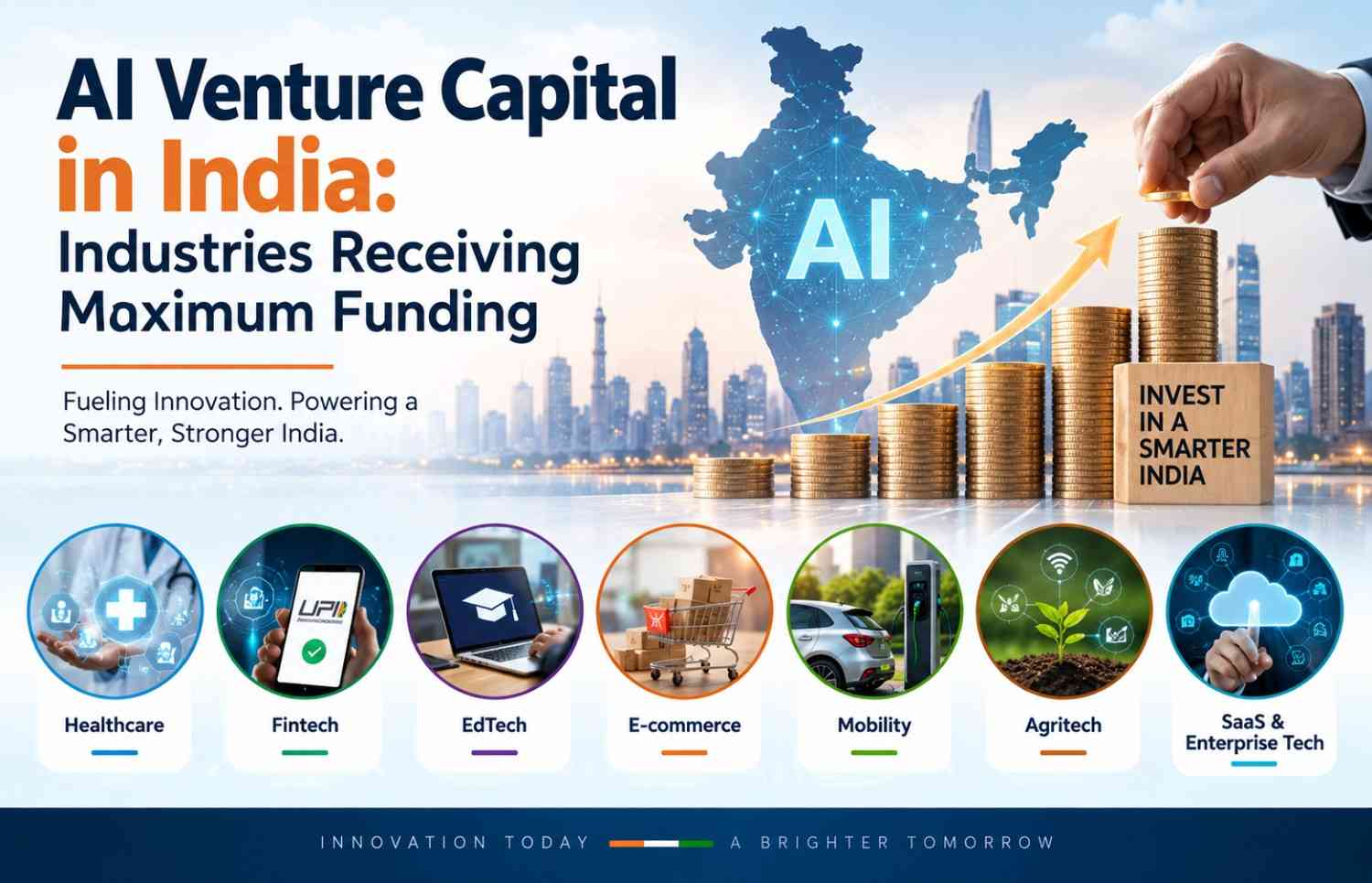
India’s artificial intelligence ecosystem has moved beyond experimentation. AI is increasingly being integrated into products, business processes, infrastructure, and consumer services, creating opportunities across several industries. As startups demonstrate stronger commercial applications for AI, venture capital activity is also becoming more focused on sectors where the technology can deliver measurable improvements in productivity, efficiency, and decision-making.
The evolution of venture capital AI India activity reflects this shift. Rather than treating AI as a standalone category, investors are increasingly evaluating how effectively artificial intelligence can solve specific industry problems. Some sectors, however, are attracting substantially more attention than others.
1. Fintech and Financial Services
Financial services remain one of the key areas for AI adoption in India. With the country’s large digital payments ecosystem, availability of financial data, and growing demand for personalised services, AI has several potential applications across the sector.
Startups are using AI for fraud detection, credit assessment, customer service, asset management, and financial forecasting. Generative AI is also being explored for document processing, compliance, and research.
Investors are particularly interested in the potential to automate routine tasks and make financial decisions faster and more accurately. However, regulatory compliance and data security remain critical considerations.
2. Healthcare and Life Sciences
Healthcare is another sector attracting growing investor interest in AI-focused startups. AI is being used for medical imaging and diagnosis, drug discovery, patient monitoring, and the automation of administrative tasks.
Artificial intelligence can help healthcare professionals analyse large amounts of data and identify patterns that might otherwise take significant time to detect. In life sciences, machine learning can support research by analysing biological and clinical data.
The potential is particularly significant in India, where technology could help improve access to healthcare across both urban and underserved regions. However, the sector also involves significant validation and regulatory requirements.
3. Enterprise Software and Productivity
AI-driven enterprise software has emerged as a key investment theme. Startups are developing products for sales, marketing, customer service, HR, cybersecurity, accounting, and other business functions.
The rise of generative AI has accelerated this trend by enabling software to handle tasks involving text, documents, data processing, and communication. Rather than simply adding AI features to existing products, some startups are building AI-led workflows designed around specific business needs.
From a VC perspective, enterprise AI becomes particularly attractive when products demonstrate recurring revenue, strong customer retention, and measurable improvements in productivity. The ability to integrate seamlessly with existing business systems is also important.
4. Manufacturing and Industrial Technology
As India continues to strengthen its manufacturing capabilities, AI is finding applications across factories and supply chains. Startups are developing solutions using computer vision, predictive analytics, robotics, and machine learning to address industrial challenges.
AI can support predictive maintenance, quality control, demand forecasting, inventory management, and production scheduling. These applications can help businesses identify operational inefficiencies and reduce potential revenue losses.
The attractiveness of industrial AI investments will depend significantly on the ability to move from pilot projects to commercially viable applications. Hardware requirements, integration costs, and longer enterprise sales cycles can make this segment different from software-focused AI investments.
5. Retail, E-commerce, and Consumer Technology
Consumer-facing businesses are increasingly using AI across different stages of the customer journey. Applications include personalised recommendations, intelligent search, demand forecasting, automated customer service, and inventory management.
Generative AI is expanding these possibilities, particularly in areas such as product discovery, content generation, and conversational commerce. However, startups still face the challenge of turning technological capabilities into sustainable business models with strong financial performance.
As a result, investors consider factors beyond customer growth, including retention, acquisition costs, revenue quality, and overall unit economics.
Also Read: Personal Loan Against Fixed Deposit vs Regular Personal Loan: Pros and Cons
6. Agriculture and Climate Technology
Given the scale of India’s agricultural sector and its dependence on changing climatic conditions, agriculture presents significant opportunities for AI. Artificial intelligence can support crop monitoring, yield forecasting, climate analysis, irrigation management, and the early detection of agricultural problems.
At the same time, climate-focused startups are exploring AI for improving energy efficiency, resource management, and environmental monitoring. These applications could become increasingly important as businesses look for more efficient and sustainable ways to manage resources.
The Road Ahead
India’s AI funding landscape is likely to become more sector-focused as the ecosystem matures. Fintech, healthcare, enterprise software, industrial technology, consumer applications, agriculture, and climate technology each present different opportunities and risks for investors.
As India’s AI ecosystem develops, the investment approach is also expected to shift from relying on broad enthusiasm around the technology to evaluating measurable business outcomes, technical differentiation, and sustainable growth.