







You need funds, and you happen to have money sitting in a fixed deposit. The instinct is to break the FD, but that means losing the interest it’s earning and often paying a premature-withdrawal penalty. There’s a better route many people overlook: borrowing against the FD without touching it. This raises a genuine question worth thinking through, should you take a loan against your fixed deposit, or simply apply for a regular personal loan?
The two are fundamentally different products. One is secured against your own savings; the other is unsecured, backed only by your income and credit profile. That single difference cascades into everything else, the interest rate, the eligibility, the speed, and the risk. Neither is universally better; the right choice depends on whether you have an FD to pledge, how much you’re borrowing, and what you’re willing to put on the line. Here’s an honest comparison.
The Core Difference: Secured vs Unsecured
A loan against fixed deposit (LAFD) is a secured loan. You pledge your FD as collateral, and the lender places a lien on it while lending you up to 90–95% of its value. Your deposit stays intact and keeps earning interest throughout. Because the lender’s risk is minimal, they can recover dues from your FD if you default, the interest rate is low and eligibility is easy.
A regular personal loan is unsecured. There’s no collateral; the lender relies entirely on your income, employment, and credit score. This makes it accessible to anyone who qualifies regardless of whether they have savings, but the higher risk to the lender translates into a higher interest rate and stricter eligibility.
Everything else about these two products flows from this one distinction.
Loan Against FD: The Pros
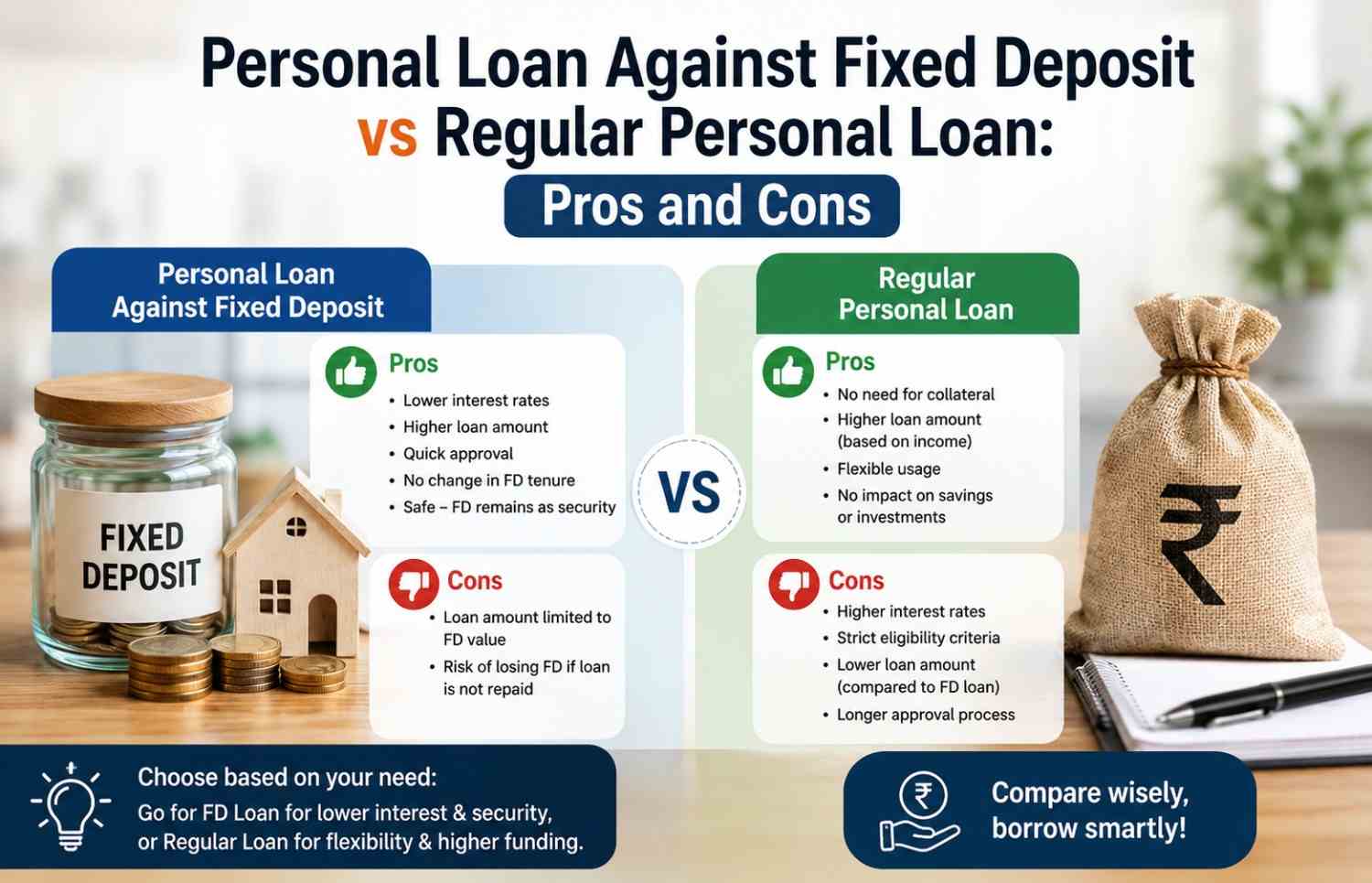
Significantly lower interest rate. This is the headline advantage. A loan against FD is typically priced just 1% to 2% above your FD interest rate. If your FD earns 7% p.a., your loan costs roughly 8% to 9% p.a., meaningfully cheaper than an unsecured personal loan. Across the life of the loan, this gap saves real money.
Your FD keeps earning. You don’t break the deposit, so it continues accruing interest at its original rate. You’re effectively borrowing against your own money while that money keeps working for you, the net borrowing cost, after accounting for the FD interest you still earn, can be strikingly low.
Minimal eligibility hurdles. Because the FD secures the loan, there’s little or no credit score check. This makes an LAFD accessible even to borrowers with a weak, thin, or non-existent credit history, first-time borrowers, retirees, or anyone rebuilding their credit.
Pay interest only on what you use. In the overdraft form, the lender sanctions a limit of 75–90% of your FD value, and you’re charged interest only on the amount you actually draw, for the days it stays outstanding. Borrow Rs. 50,000 from a Rs. 2 lakh limit, and you pay interest on Rs. 50,000 alone.
No prepayment penalty. You can repay early without the foreclosure charges that unsecured loans often carry, since the lender simply recovers its interest from the secured deposit.
Loan Against FD: The Cons
You need an FD to begin with. The obvious limitation, this option only exists if you already hold a fixed deposit. No FD, no LAFD.
The loan is capped at your FD value. You can borrow only up to 90–95% of the deposit. If you need Rs. 10 lakh but your FD is worth Rs. 3 lakh, an LAFD can’t cover it. Your borrowing ceiling is your savings, not your income.
Your FD is at risk if you default. If you fail to repay, the lender adjusts the outstanding dues against your FD. You lose the deposit you were trying to preserve. The security cuts both ways.
The FD is locked as collateral. For as long as the loan is active, you can’t liquidate or use that FD for anything else. It’s tied up until you repay.
Also Read: How to Open a Free Demat Account Without Hidden Charges
Regular Personal Loan: The Pros
- No collateral required: You don’t need any asset, no FD, no property, nothing pledged. The loan rests on your income and credit profile, which keeps your savings and assets entirely free.
- Much higher loan amounts: A regular personal loan isn’t capped by your savings. The Bajaj Finserv personal loan offers Rs. 40,000 to Rs. 55 lakh, sized against your income and repayment capacity rather than a deposit. For large needs, this is the only route of the two that can deliver.
- Fast, fully digital access: Through a personal loan app, disbursal happens within 24 hours of approval, as fast as 30 minutes for eligible Insta Personal Loan customers. The Bajaj Finserv loan app handles the entire process digitally with Aadhaar-based eKYC.
- Flexible tenure: A regular personal loan offers tenures up to 108 months, letting you spread repayment far longer than an FD-linked loan, which must be repaid before the FD matures.
Nothing of yours is at stake. Since there’s no collateral, a default damages your credit score and triggers recovery, but it doesn’t cost you a specific asset you’d pledged.
Regular Personal Loan: The Cons
Higher interest rate. Being unsecured, it costs more. The Bajaj Finserv personal loan starts from 10% p.a. and ranges up to 30% p.a. depending on your profile, higher than the FD-rate-plus-1-to-2% of an LAFD.
Stricter eligibility. You need a qualifying income and a CIBIL score of 685 or above. Borrowers with weak or thin credit may struggle to qualify, whereas an LAFD would have been accessible.
Credit score dependency. Your rate and eligibility hinge heavily on your credit history. A lower score means a higher rate or rejection, a hurdle that doesn’t exist with a secured FD loan.
A Side-by-Side Summary
The trade-offs line up clearly:
- Interest rate: LAFD is cheaper (FD rate + 1–2%); personal loan is higher (from 10% p.a.).
- Loan amount: LAFD is capped at 90–95% of your FD; personal loan goes up to Rs. 55 lakh.
- Eligibility: LAFD needs little to no credit check; personal loan needs a 685+ CIBIL and qualifying income.
- Collateral: LAFD locks your FD; personal loan needs none.
- Risk of default: LAFD costs you your FD; personal loan damages your credit but no pledged asset.
- Speed: Both are fast; personal loan disburses within 24 hours through the app.
Which Should You Choose?
Choose a loan against FD if you already have a fixed deposit, your borrowing need is within 90% of its value, and you want the lowest possible interest rate. It’s ideal for borrowers with a weak credit score, retirees on fixed income, or anyone who wants cheap, quick funds without breaking their savings. The overdraft form is especially good for irregular or short-term needs where you draw and repay repeatedly.
Choose a regular personal loan if you don’t have an FD, your need exceeds what a deposit could cover, or you’d rather not put your savings at risk. For a Rs. 10 lakh wedding, a large medical expense, or debt consolidation beyond your FD value, the Bajaj Finserv personal loan is the practical choice, higher amounts, longer tenure, and nothing of yours pledged.
For many borrowers, the smartest move is to use both strategically: an LAFD for amounts within your FD value at the lowest cost, and a personal loan for anything larger.
Applying Through Bajaj Finserv
Personal loan from Bajaj Finserv is available to salaried applicants aged 21 to 80, with a minimum monthly income of Rs. 25,000 (higher in metros) and a CIBIL score of 685 or above. Apply through the personal loan app, register, verify with OTP, upload KYC and income documents, choose your variant and tenure, and receive disbursal within 24 hours. Check for pre-approved offers first using just your mobile number and OTP, which won’t affect your credit score.
Before accepting any loan, read the Key Fact Statement for the APR, the true annualised cost including all fees, and confirm the loan app is listed on the RBI’s Digital Lending Apps directory at rbi.org.in.
The Bottom Line
A loan against fixed deposit and a regular personal loan solve the same problem, a need for funds, in opposite ways. The LAFD is cheaper, easier to qualify for, and keeps your savings earning, but it’s limited to your FD value and puts that deposit at risk. The personal loan costs more and demands a solid credit profile, but it delivers far larger amounts, longer tenures, and leaves your assets untouched.
Match the tool to your situation: if you have an FD and your need fits within it, borrowing against it is almost always the cheaper choice. If you need more than your savings can cover, or have no FD to pledge, the Bajaj Finserv personal loan is the flexible, higher-limit option. Weigh the interest saving against the risk to your deposit, model the numbers before you commit, and choose the loan that meets your need at the lowest real cost.